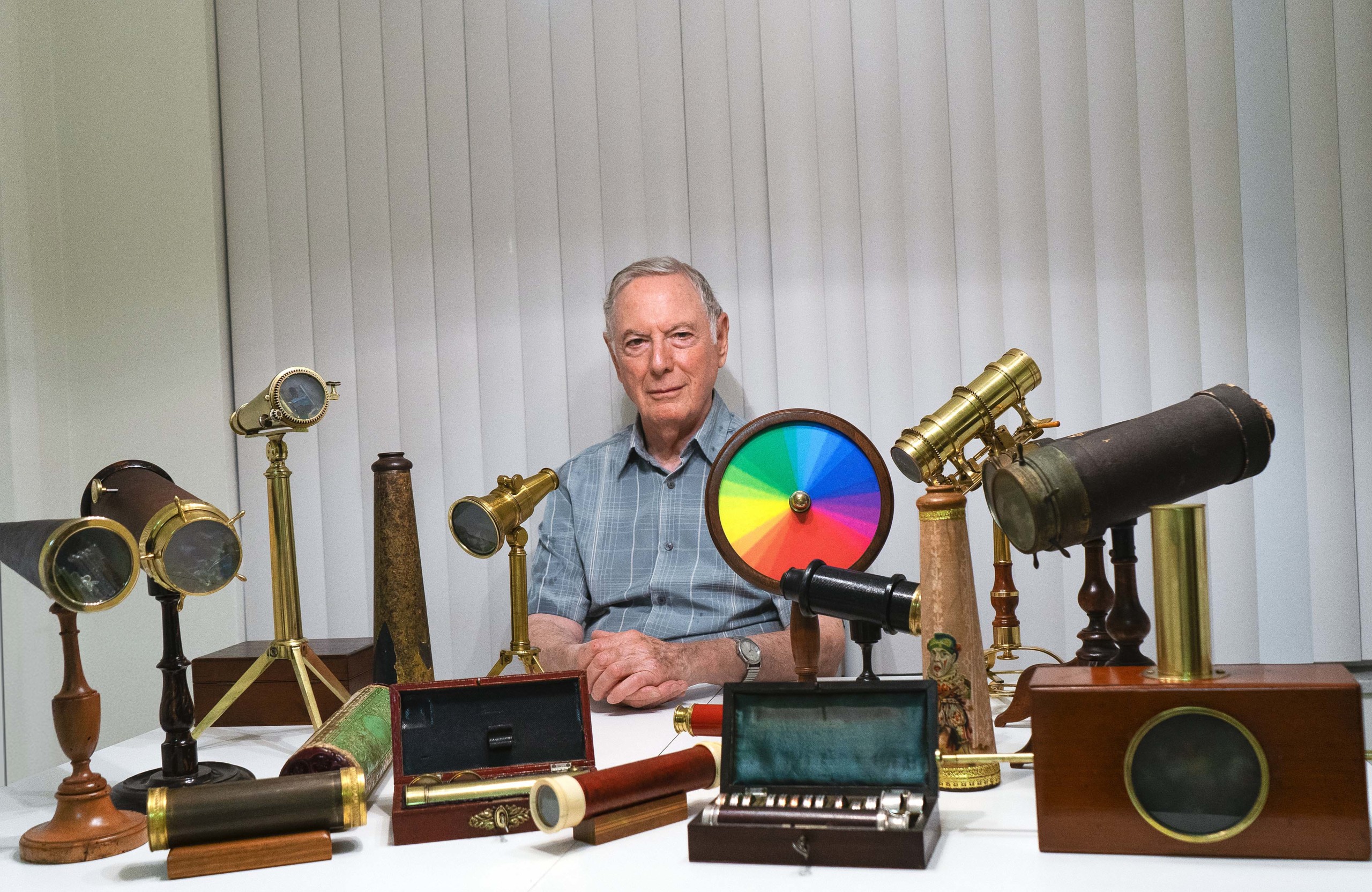
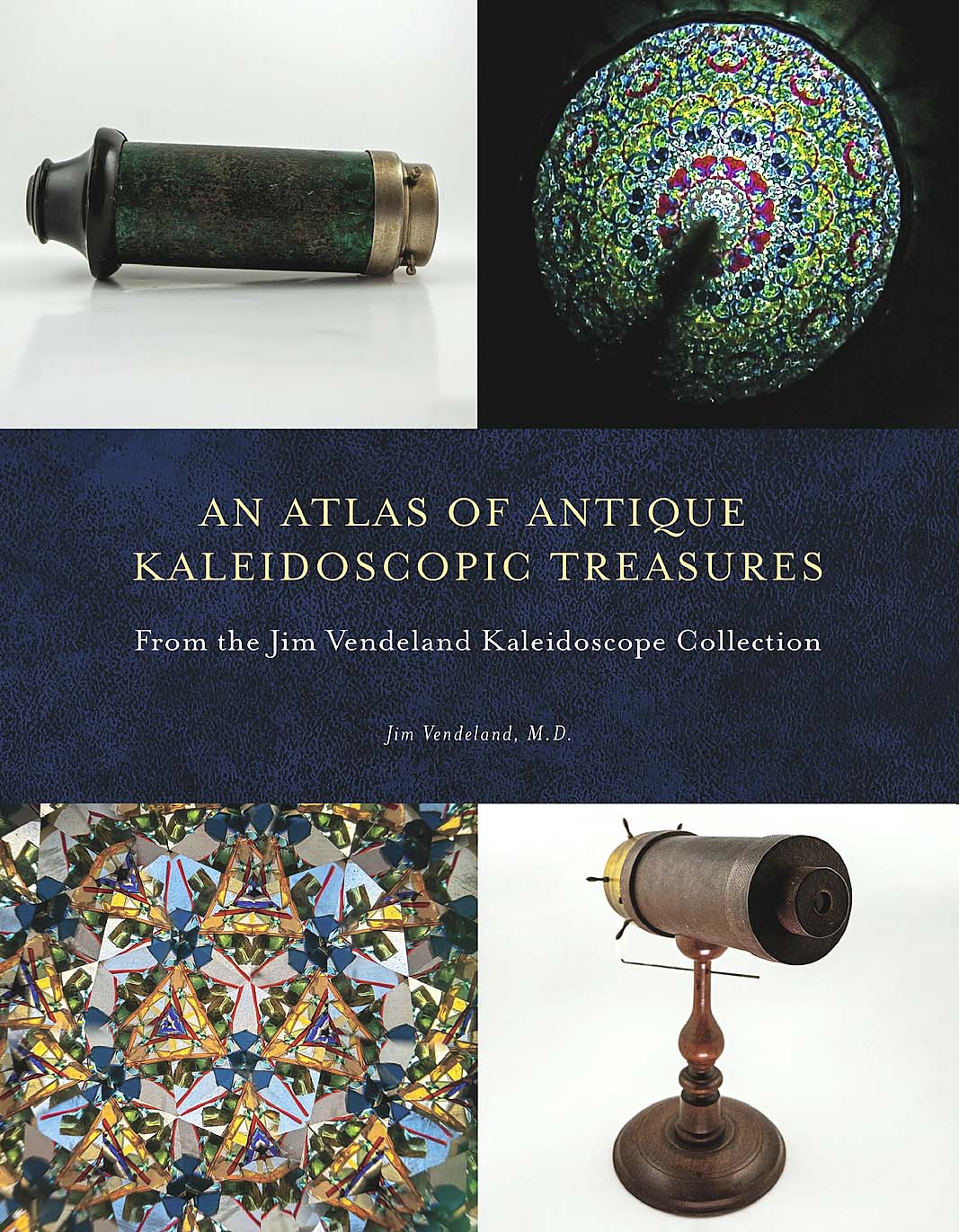
Dr Jim Vendeland, a retired ophthalmologist, knows all about how lenses can change the way we interact with the world. When he wasn’t fitting patients for eyeglasses to help them see clearly, he was collecting antique eye instruments, eventually accumulating a large collection of antique kaleidoscopes. This passion culminated in An Atlas of Antique Kaleidoscopic Treasures: From the Jim Vendeland Kaleidoscope Collection. When we caught wind of this book, we connected with him to learn more about the collection.
Do you remember your first experience with a kaleidoscope?
Yes. As a small boy, I received a toy kaleidoscope as a present. I looked into it for about 30 seconds, said “That’s neat,” then moved on to the next toy. It’s probably not the big inspirational moment you thought it would be… That toy wasn’t what got me interested in collecting them.
So, how did you come to collect antique kaleidoscopes?
During my entire career as a physician, I used a variety of optical instruments to examine the human eye. So, it was not a surprise for me to gravitate toward scientific instruments, especially those that are optical in nature such as the kaleidoscope. I was also very fortunate to be a volunteer at the Dittrick Medical Center in Cleveland, Ohio, for a period of 10 years. There, I was exposed to all kinds of antique medical instruments, which were visual in nature.
For me, the kaleidoscope is not merely a child’s toy but also an instrument of beauty with some practical implications. One such practical implication could be used to treat hyperactivity or anxiety in children. Scientists are studying the effects on brain activity when a child looks at the patterns, and they might help calm the mind. These practical implications could be medical or psychological, but also large scopes have been designed to transfer the kaleidoscope’s geometric patterns to fabric, so also for design and fashion.
Are these antiques hard to find?
Antique kaleidoscopes are hard to find, and the better, more expensive ones are usually obtained at auction. On online venues such as eBay, one can search and find numerous modern and vintage kaleidoscopes; but only rarely does an antique instrument appear.
According to my own classification, any kaleidoscope created before 1900 would be considered an antique. The modern kaleidoscope era would begin in the 1980s. The vintage kaleidoscopes would fall in between the antique and modern categories.
The modern era was really sparked by Cozy Baker, who, after the death of her child, found a kaleidoscope and said its views immediately alleviated some of the grief she was feeling. As a result, she became like a patron of the craft — collecting them, studying them, educating others and eventually founding The Brewster Society.
I’d love for you to share a few items from your collection: the oldest, the newest and your most recent acquisition.
It should be stated that I probably have about 200 antique examples in my collection.
Sir David Brewster was a brilliant scientist, author and inventor. He invented the kaleidoscope in 1817. I have been very fortunate to have acquired several of his original kaleidoscopes.
The most recent one is a Victorian brass and leather kaleidoscope, circa 1860.
The newest kaleidoscope, which I recently bought, is a Vintage Longue Vue Magique Teleidoscope, dating from 1952. The teleidoscope is a combination of part telescope and part kaleidoscope and has different images than a traditional kaleidoscope.
How have kaleidoscopes changed throughout history?
The Brewster kaleidoscope of 1817 resembles the general public’s concept of a kaleidoscope. It consists of a hollow barrel of metal, wood or paper. At one end of this barrel is an eyepiece through which the observer looks. At the other end is an object chamber filled with “stuff.” This usually consists of small pieces of colored glass but could be made of any kind of material. Inside the barrel of the kaleidoscope are wedged two or three strips of mirrors. The light source was originally sunlight but now can be any form of illumination. When the light source shines on the object chamber, which is rotated by the barrel, the “stuff” inside the object chamber moves all over inside the chamber. The images thus formed by the mirror system inside the barrel create an almost infinite number of beautiful geometric patterns called mandalas. This is the standard kaleidoscope form from 1817 to about 1873.
In 1873, Charles Bush invented his parlor kaleidoscope. It was the Cadillac of kaleidoscopes and was meant for the wealthy, whereas the Brewster models would appeal to and be more affordable by the masses. In the middle of the Nineteenth Century, the first toy kaleidoscopes appeared. They were cheaply made, and most have not survived due to child misuse and cheap materials. The era of the modern kaleidoscope began in the 1980s by Cozy Baker and the establishment of the Brewster Kaleidoscope Society. It is composed of kaleidoscope makers and collectors. Designs of these instruments both internally and externally can be whatever the instrument maker can create, and some can sell for thousands of dollars! It really is an artform and unfortunately it has been neglected…no museums in the US have exhibitions on kaleidoscopes.
Who were your collaborators in researching for your book?
I could not have done this book without my photographer Chris Lisak, who came to my apartment weekly for over two months in order to photograph the collection. I am also indebted to Wiley Jobe of New York and Erik van Cort of Virginia who restored many of my antique kaleidoscopes that appear in my book. They are meticulous artists and the only two kaleidoscope restorationists that I know of.
—Carly Timpson
[Editor’s note: An Atlas of Antique Kaleidoscopic Treasures is available for purchase online through BookBaby or Amazon.]