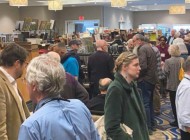
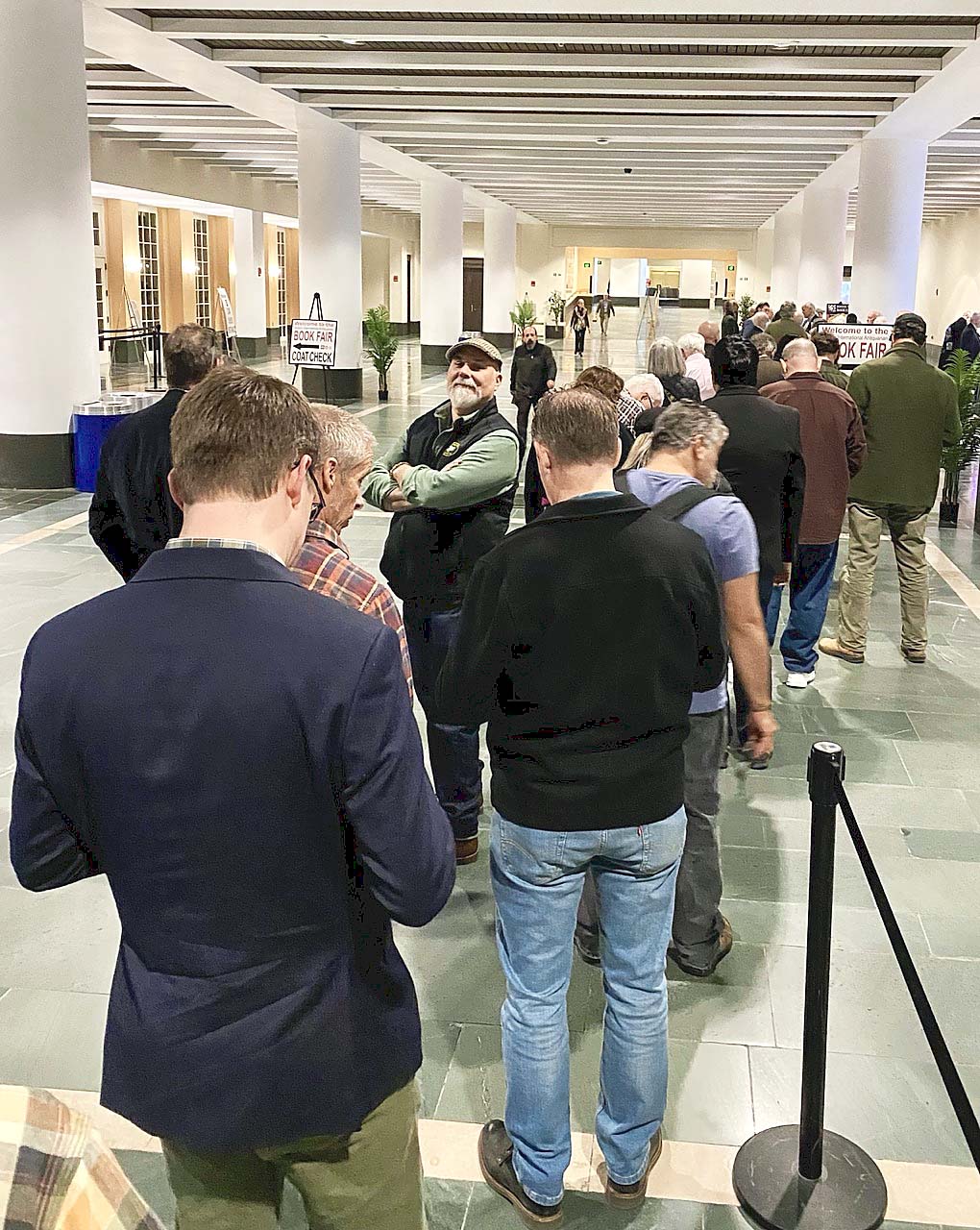
All heads down but one in the ticketed entry line on Friday, November 7.
Review & Onsite Photos by Z.G. Burnett
BOSTON — The 47th Boston International Antiquarian Book Fair presented by the Antiquarian Booksellers’ Association of America (ABAA) opened at the Hynes Convention Center on November 7 and ran through November 9, for visitors with paid tickets and quietly voracious passion. By opening time at 4 pm, a line of patrons stretched across the second floor lobby and all were abuzz with excitement. “The fair was definitely a success this year,” said Julie K. Roper, executive producer. “We had increased attendance on Saturday, and dealers were happy!”
One of the fair’s rarest pieces was from Peter Harrington: a manuscript copy of Robert Frost’s “The Need of Being Versed in Country Things,” the final poem in his key collection, New Hampshire (1923). Possibly a draft version, Frost inscribed this manuscript for Loring Holmes Dodd (1879-1968). A lifelong friend and professor of English and art at Clark University, Dodd first met Frost after the poet gave a reading at the university in 1923. He inserted a selection of woodcuts by J.J. Lankes into his personal copies of Frost’s North of Boston (1914) and Mountain Interval (1916) that he felt matched the poems perfectly and showed them to Frost. This prompted the poet to commission four woodcuts from Lankes for New Hampshire and full illustrations for his next book West-Running Brook (1928). At press time, the autographed manuscript poem was still available.
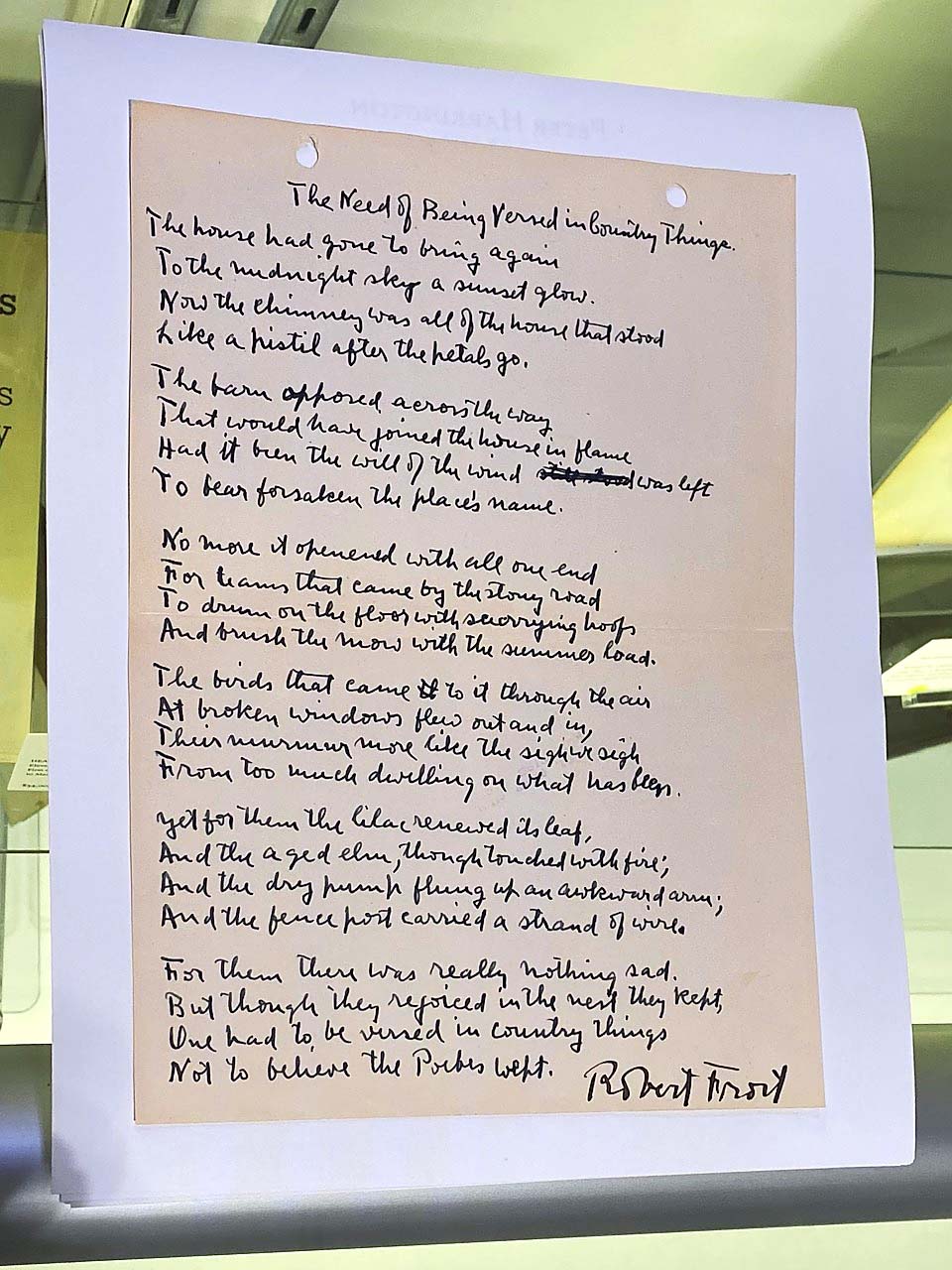
A rare handwritten and signed copy of one of Robert Frost’s most defining poems, “The Need of Being Versed in Country Things,” was presented by Peter Harrington, London.
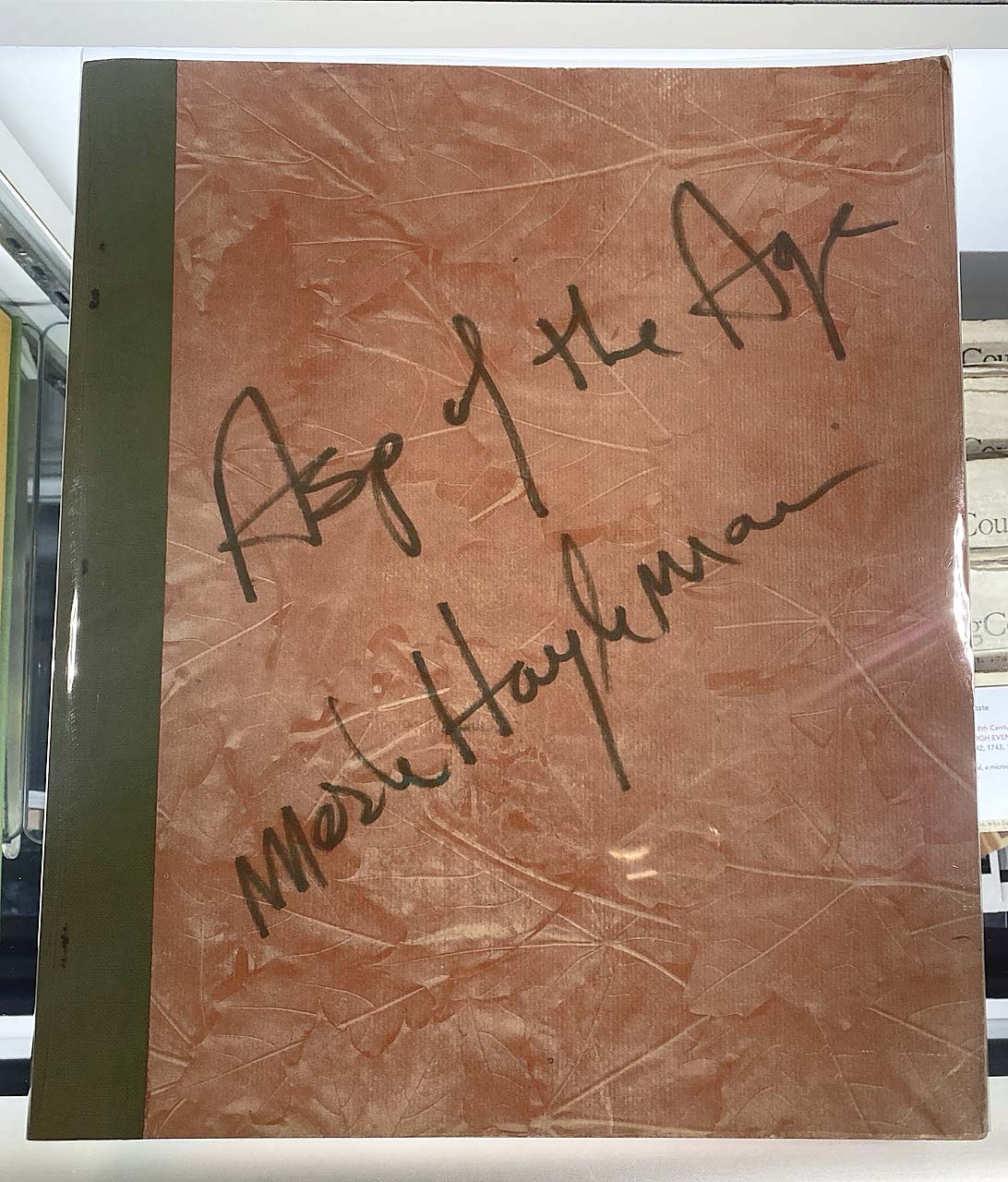
Another singular yet far less known Twentieth Century American poet’s only officially published work appeared in a case with Type Punch Matrix. Merle Hoyleman’s (1905-1984) obscure 30-year career culminated in a now-lost local access interview. Privately published in 1966 after many attempts, Hoyleman insisted that the text be a facsimile of her original handwritten manuscript and claimed that she transcribed the poetry from spirit communication. In the aforementioned interview, she was displeased when the station failed to hire actor Richard Burton for a reading from Asp. As in life, Hoyleman’s poetry is “[appreciated by] a small number of discerning admirers” including poet and professor CAConrad [sic] (b 1966) who cited her as a major influence in episode 157 of The Witch Wave podcast that aired earlier that week, on November 5.
Customers searching for similarly strange and unusual titles made a beeline for Lux Mentis Booksellers and were not disappointed. Lux Mentis offered a UK first edition of Witchcraft Today by Gerald B Gardner (1884-1964), published in 1954 with its original dust jacket in very good condition. Gardner is often called “the Father of Wicca,” an earth-based religion that draws from pre-Christian pagan beliefs that his work helped to popularize in the Twentieth Century as founder of the Gardnerian Wicca tradition. The introduction by archaeologist and anthropologist Margaret B. Murray (1863-1963) is also of note. With a second wave of occult interest only gaining more traction with every passing year, interested parties would do well to read such classics.
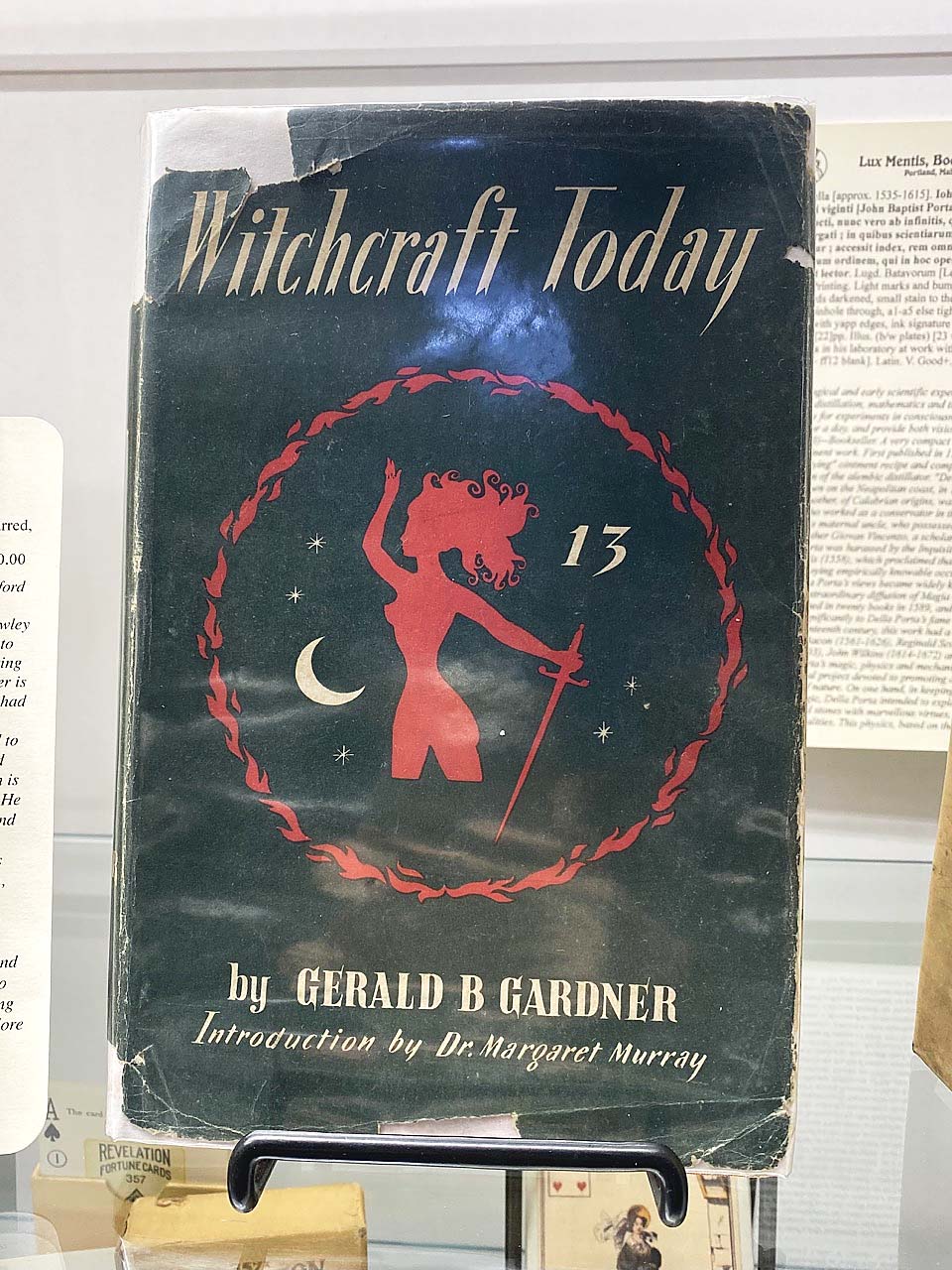
Witchcraft Today, Gerald Gardner’s pivotal publication that helped to launch the modern neopagan movement, was displayed by Lux Mentis, Portland, Maine.
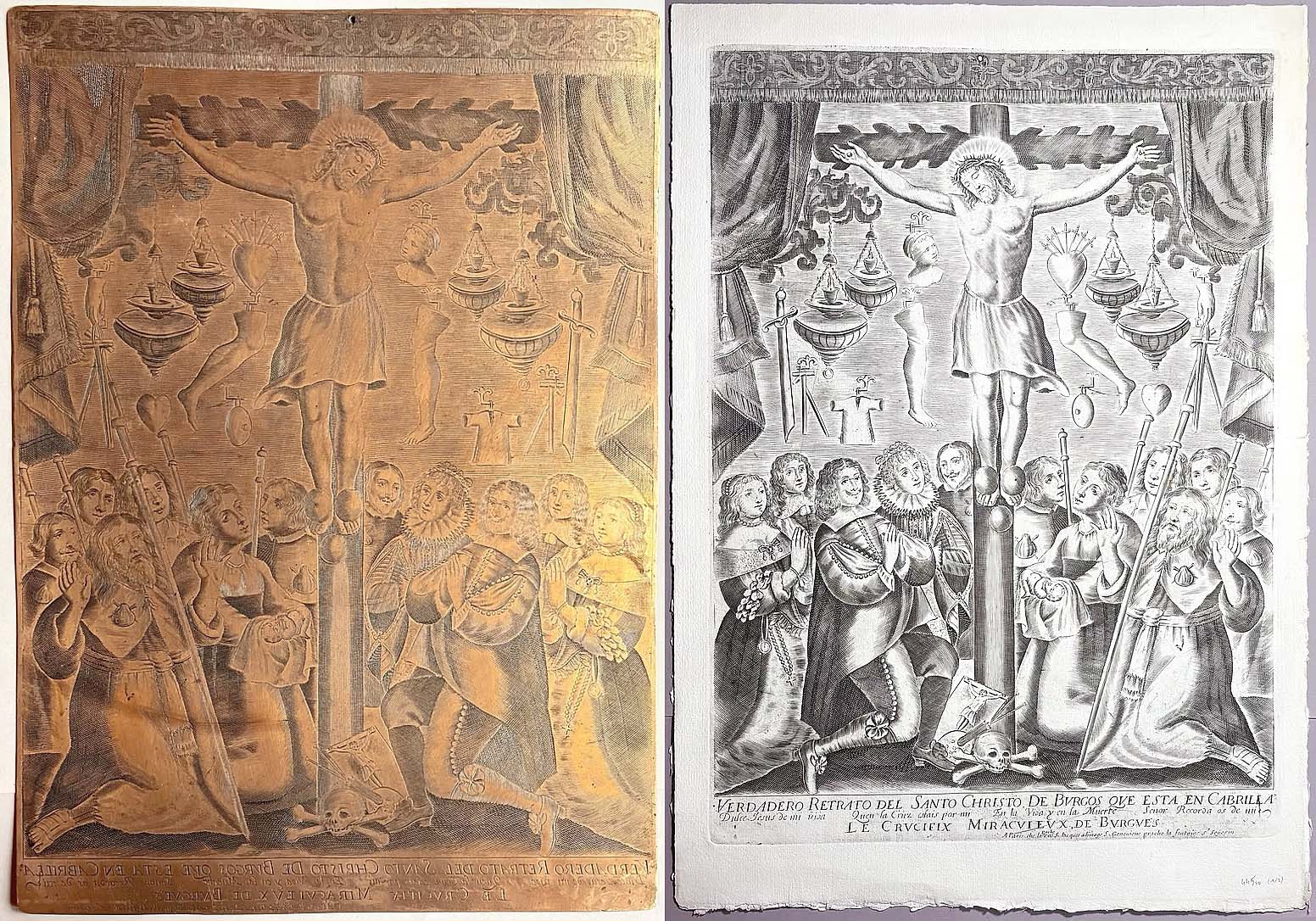
Marshall Kibbey Rare Books presented a striking piece of Christian iconography and history. Shining brightly at approximately 15 by 21 inches was an engraved copper plate showing veneration of the “Miraculous Crucifix of Burgos.” The plate dated to about 1700 and was made in Paris on the Rue St-Jacques, possibly the oldest street in Paris and the beginning of a pilgrimage route to Santiago de Compostela in Spain that is still used today. It includes the cathedral at Burgos, Spain, as a site of worship. The engraving shows “well-to-do” pilgrims, identified by their walking sticks and shell necklaces, and patrons on either side of the crucifix, around which ex-votos with body parts are hung for specific healing prayers. At the base of the cross is an unusual contemplative addition of a skull and crossbones, a painter’s palette and another crucifixion image.
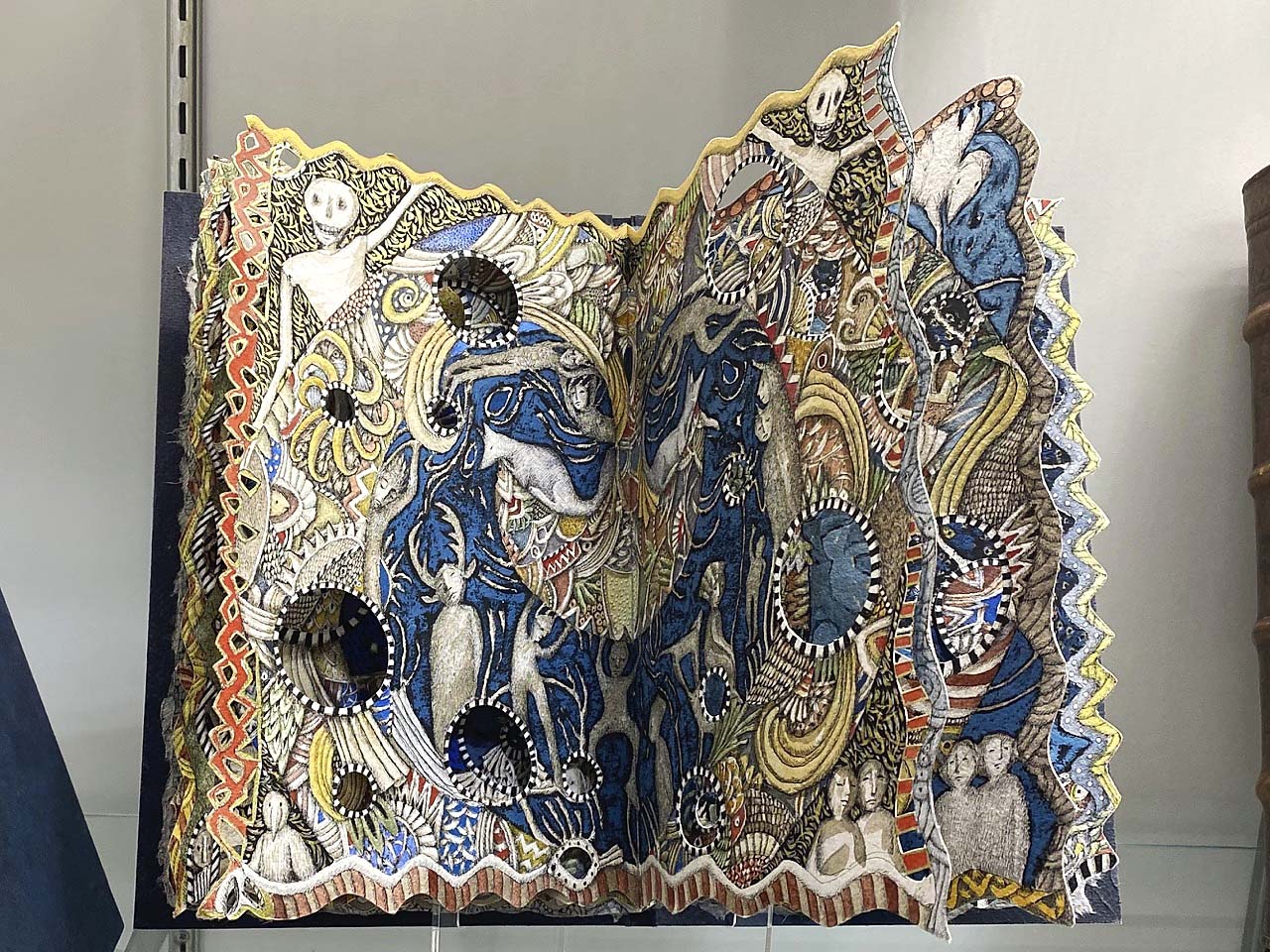
Another contemporary example of metaphysical book art drew much attention to the booth of Justin Croft Antiquarian Books. Diane de Bourzanel (b 1956) is a painter and illustrator who creates handmade multimedia books made with “days of painstaking drawing, hand coloring, collage, papercutting and binding combined to create unique stories.” Each book examines universal themes such as love and loss, life and death and all the human yearning and joy experienced therein. Designed as codexes, De Bourzanel’s narratives encourage the reader to engage with them by “reading” the illustrations forwards, backwards and even through the pages to discover their own sightlines and subjective stories. From Croft’s description, “Les Yeux au ciel contains one of the densest concentrations of De Bournazel’s unique symbolism to date, its 16 pages bearing a plethora of human, animal and hybrid figures (some prominent, others slyly hidden) and a vortex-like mise en page.”
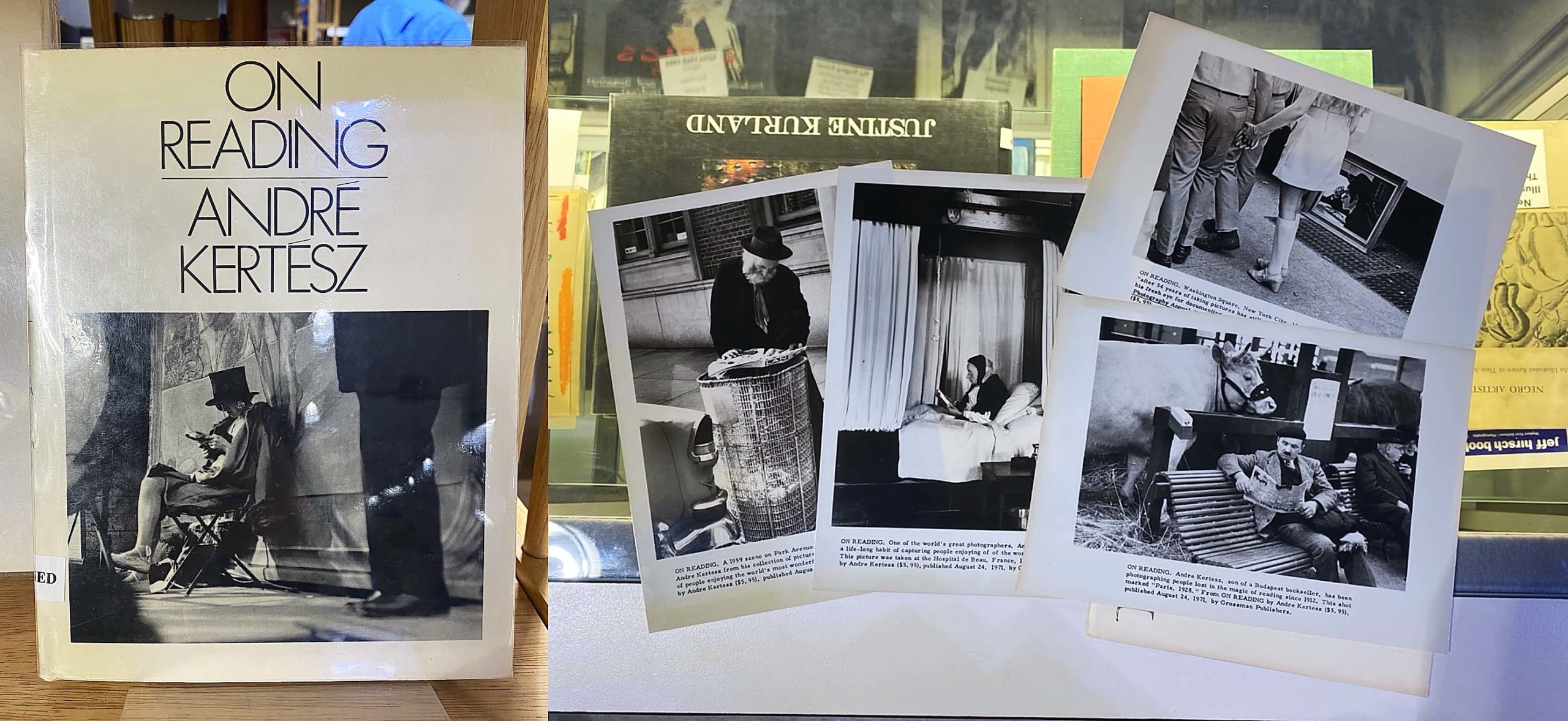
Published in 1971, this publisher’s copy of André Kertész’s On Reading was signed and inscribed to the famed New York City gallerist Lee Witkin the same year. Jeff Hirsh Books, Chicago.
Jeff Hirsch Books brought a classic photography book that also interrogated the concepts of “reading” and “viewing.” On Reading by André Kertész is a collection of 66 black-and-white photographs, all featuring people reading. Kertész (1894-1985) was born in Budapest and emigrated to the United States in 1936, having established acclaim as a photojournalist. Soon his specific treatment of contemporary subjects with formalist composition gained recognition in the nascent American market of modern and contemporary art. This first printing and first edition was also signed and inscribed by the author to Lee Witkin, one of the first New York City gallerists to open a space exclusively selling contemporary photography in 1969. It included four press photos and a full publisher’s description, “a clean and tight near fine copy in a near fine dust jacket.”
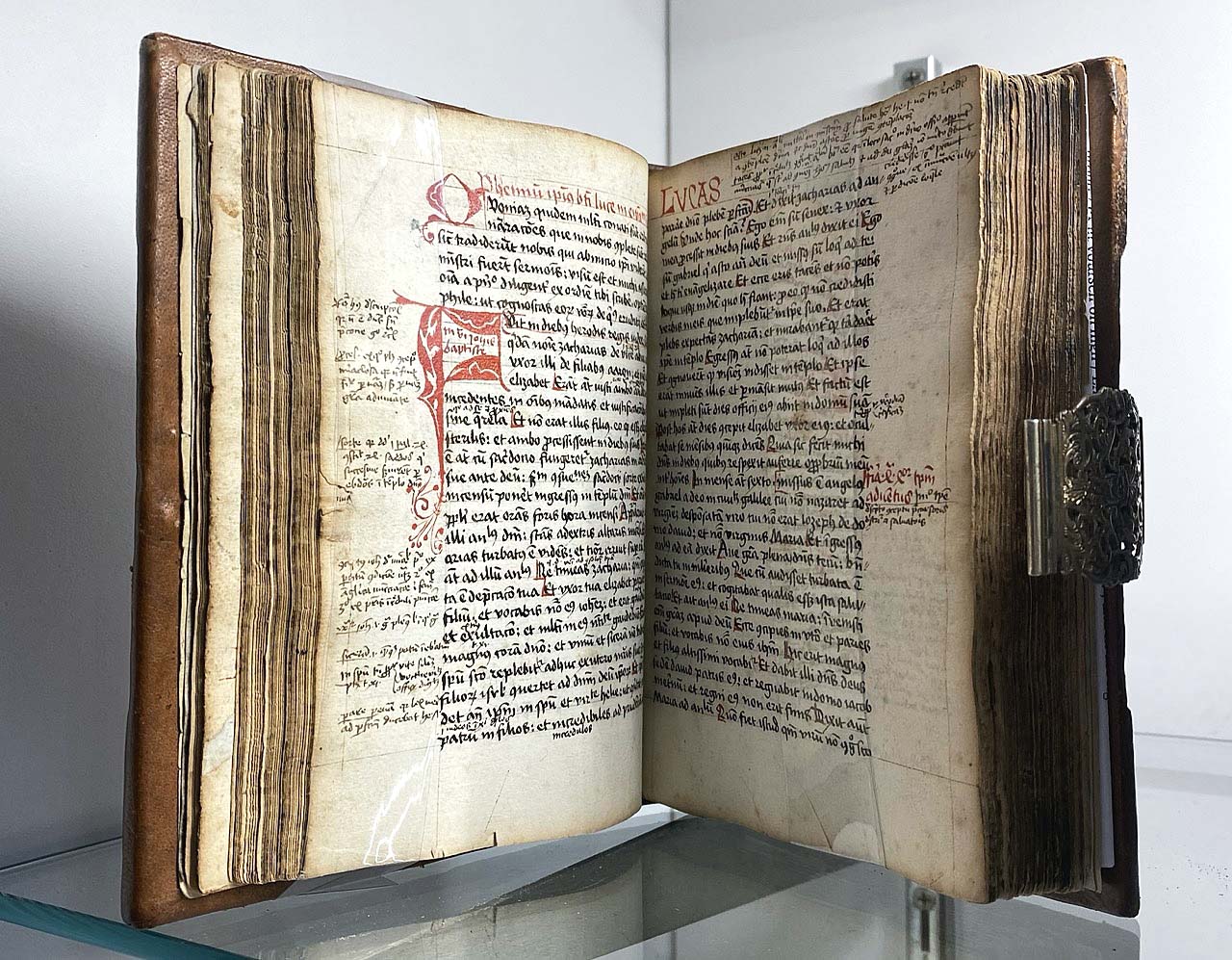
Those uninitiated into the world of book collecting may incorrectly assume that books made before the time of the printing press have nothing to teach the general reader. Robert A. van den Graven of Konstantinopel Rare Books contested that view with a Bavarian, most likely Kelheim-made, manuscript of the New Testament dated to the second half of the Fifteenth Century. Written mostly in Latin and containing the Catholic epistles, “distinctiones” on Christian values and senses grouped by five and seven, the Apostle’s Creed, an attribution to Saint Francis and the Epistle to the Hebrews, the manuscript ends with a German beer recipe called “covent,” the potus pauperum or drink of the poor. This was a “small,” low-alcohol beer drunk in monasteries when water was only suitable for cleaning or washing, probably preserved by a Franciscan novice or young monk. Early beer recipes are extremely rare, and this example might have gone unnoticed for centuries. Ex the Duke of Sussex’s library, the manuscript was last sold by Sworders Fine Art Auctioneers this year.
The Boston International Antiquarian Book Fair occurs annually; the 2026 dates have not yet been announced. For more information, www.abaa.org.