




By Madelia Hickman Ring
The 2024 issue of the Chipstone Foundation’s American Furniture journal is hot off the press; it’s the first issue solely edited by Martha Willoughby, who assumed the editorial torch from emeritus editor Luke Beckerdite in 2024. The end papers to the 2024 issue feature the covers of all 30 issues Beckerdite edited himself, and Willoughby pays tribute to his decades-long contributions in her introduction, noting, among other things, 17 articles he authored or co-authored.
Add to that list is one Beckerdite wrote that is the first article in the current volume, titled “Not the Cupola House Carver.” Here, he challenges the attribution of a group of furniture made in Edenton, N.C., to a man, who was previously identified as Samuel Black, the “Cupola House Carver.” In his essay, Beckerdite’s analysis relies on the importance of design, habit and proficiency of the carvers to arrive at the conclusion that the furniture in the group was made by two different hands, none of which were present in work from the Cupola House.
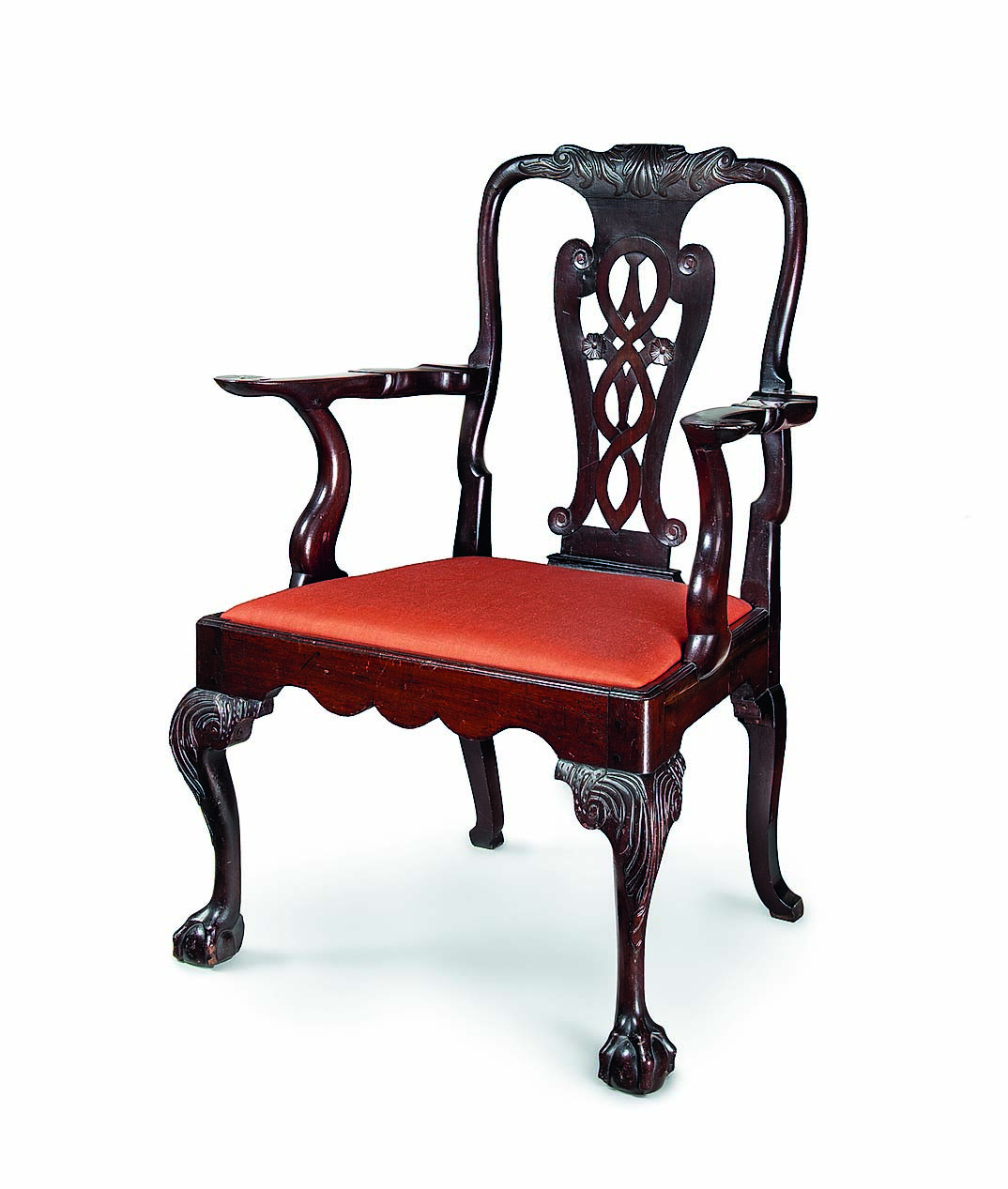
Armchair, vicinity of Edenton, N.C., 1745-65, mahogany and cherry with cypress and beech. Photo courtesy the Museum of Early Southern Decorative Arts. Gavin Ashworth photo.
In “Sitting on the Severn: A Group of Mid Eighteenth Century Chairs from Annapolis,” Daniel Ackermann’s research tackles the comparative dearth of material culture scholarship of this Mid-Atlantic region and examines the seating furniture made by a small group of makers between 1745 and 1760. His essay begins with a single-page photo essay on furniture from Annapolis’ Brice House and the Brice family armchair that appeared in the January 1935 issue of Antiques magazine. Ackmann continues with a brief survey of subsequent exhibitions and findings on Maryland furniture. The Brice family chair, as Ackermann’s essay points out, is linked to a small group of mid Eighteenth Century Annapolis-made seating furniture. An Irish influence is introduced, outlined by trade with Irish ports and the growing population in Maryland of Irish indentured servants, some of which were craftsmen. After noting that the craftsman database at the Museum of Early Southern Decorative Arts (MESDA) has identified that in pre-Revolutionary War Annapolis, there were more than 750 craftspeople present, of which “316 worked with wood as cabinetmakers, carpenters and joiners”; Ackermann names four men “associated with the cabinetmaking or chairmaking trade in Annapolis” between 1745-60: John Anderson (d 1759), Gamaliel Butler (d 1756), Robert Harsnip (d 1762) and John Pennington (d 1750). Of these, Anderson is the most likely candidate based on his working dates and what is known from the historical record.

Armchair, Annapolis, Md., 1745-55. Walnut and yellow pine. Private collection. Daniel Kurt Ackermann photo.
Brock Jobe and Kemble Widmer, in “William King and a Century of Misattributions,” explore the objects associated with Salem, Mass., cabinetmaker William King, a craftsman to which just 10 labeled pieces survive but to whom an astonishingly large number of case pieces had been attributed, based solely on the presence of gadrooning along the upper half of the feet. Relying on more biographical information that has surfaced since the early scholarship on King, Jobe and Widmer present a clearer picture of the history of King. Critically, they point out the differences in not only feet gadrooning but also case construction support attributions to multiple shops. In their object study, the authors located 42 pieces of furniture with possible connections to King and examined 38 of them: desks, desk-and-bookcases, chests, a chest-on-chest, a candlestand, two card tables and a set of chairs. Four discrete groups of case furniture emerged clearly, as the work of four different shops.
Jobe and Widmer identify Thomas Needham, Jr, as the maker of several pieces formerly attributed to King; a second group from a distinct but unattributed shop in the Salem or Beverly, Mass., area share distinct construction techniques. Related elements connect another group to a third shop, which has also yet to be linked to a specific craftsman. The fourth group, Jobe and Widmer argue, was likely the work of “an artisan outside the [Salem] community.”
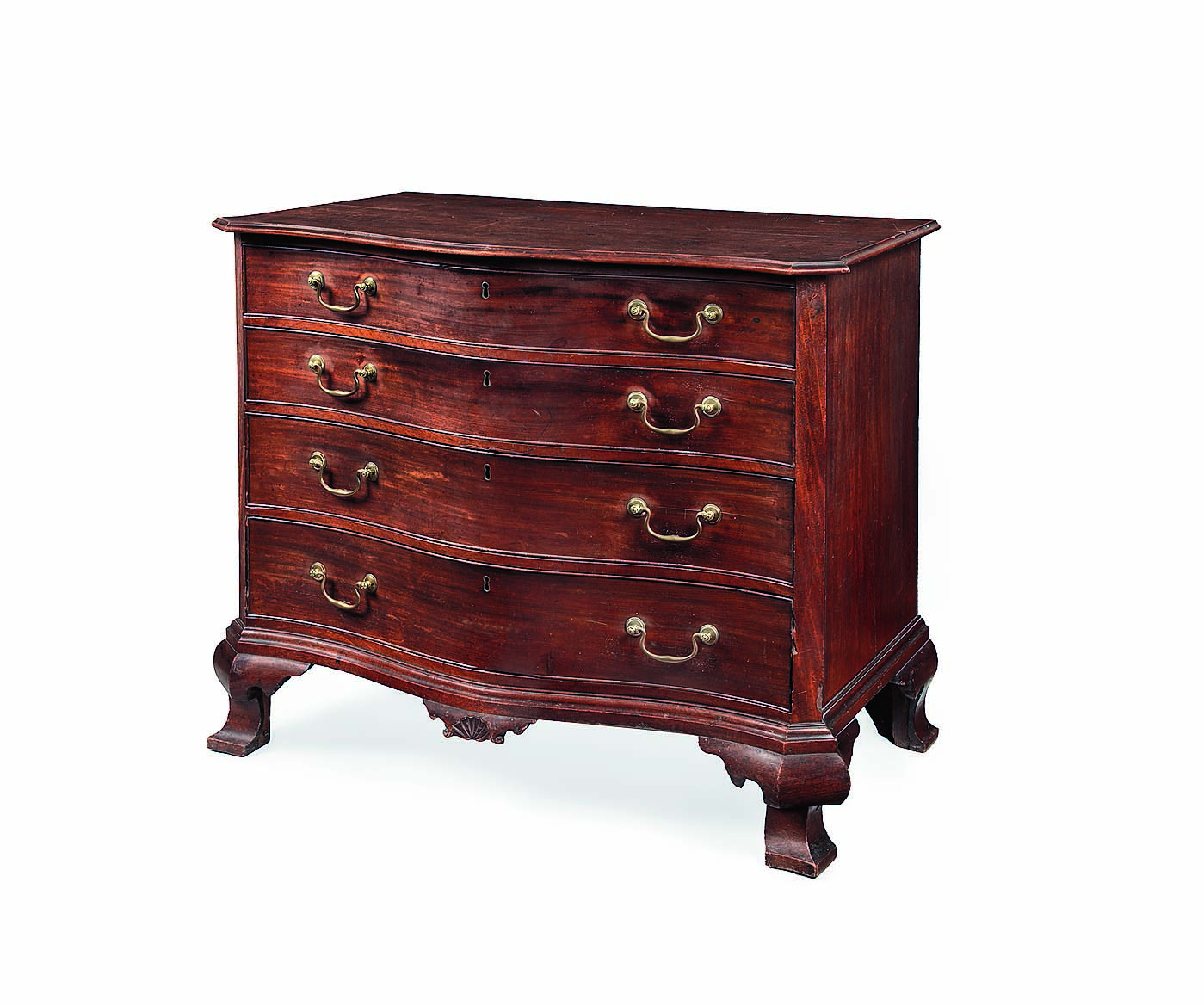
Chest of drawers, labeled by William King, Salem, Mass., 1788-93, mahogany with white pine. Private collection. Gavin Ashworth photo.
Lance Humphries posits, in “New Furniture for Emerging Social Refinement: Colonel Thomas Tenant’s Finlay Suite Identified,” a connection linking a yellow painted lyre-base card table and a suite of furniture made for Baltimore merchant, Colonel Thomas Tenant (circa 1767-1836) in the Baltimore shop of John (1777-1851) and Hugh (1781-1836) Finlay.
What is known about Tenant has been piece together from public records and contemporary newspaper advertisements and notices. By 1816, was regularly associating with prominent local figures and was considered to have become a member of Baltimore’s elite and built a house in a prestigious part of the city, near other wealthy citizens and, conveniently, less than three blocks from the North Gay Street address of the Finlays’ shop. With many of his neighbors patronizing the Finlays, Tenant followed suit. His furnishings are outlined in his 1836 estate inventory, an 1842 sales notice and an account of sales dated 1842. From these, Humphries has been able to create a checklist of surviving pieces from Tenant’s collection.
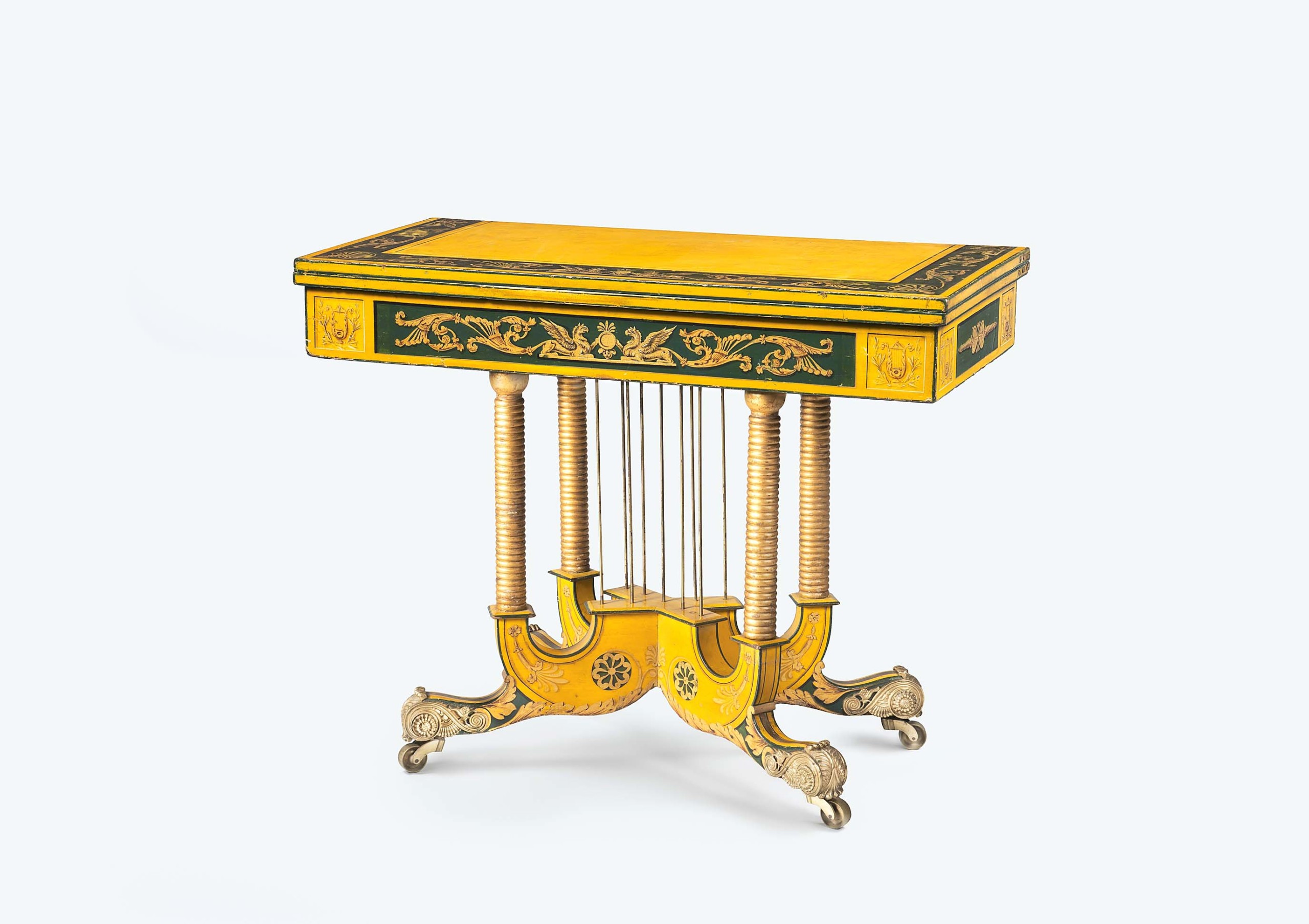
Card table, attributed to the shop of John and Hugh Finlay, Baltimore, circa 1815, mahogany, tulip poplar, maple; painted and gilded decoration, baize, brass. Courtesy the Philadelphia Art Museum, gift of the Stanley Weiss Collection in recognition of the scholarship of Alexandra Kirtley, curator of American decorative arts, 2018. Gavin Ashworth photo.
In the final essay for the issue, “A Family Legacy: Classical Furniture by Mark Pitman in the Ropes Mansion, Salem, Massachusetts,” Dean Lahikainen does a deep dive into a group of nearly 50 pieces made between 1812 and 1840 by Mark Pitman (1779-1855) for various members of the Ropes-Orne family that survive in Salem’s Ropes Mansion. The survey demonstrates Pitman’s remarkable longevity and breadth of work, ranging from a circa 1807-12 desk-and-bookcase to a pole screen probably made between 1835 and 1836.
Lahikainen follows his essay with four appendices: the first is a checklist of furniture in the Ropes collection, the second identifies key characteristics of Pitman’s Classical furniture, while the third shows 14 surviving receipts written by Pitman for furniture and other services rendered to the Ropes-Orne family between 1807 and 1839. A family tree of Ropes-Orne family members and occupants of the Ropes Mansion rounds out his scholarship.
Gerald W.R. Ward includes a perennial bibliography of new and recent writing on American furniture, an indispensable and concluding feature of each previous issue of American Furniture.
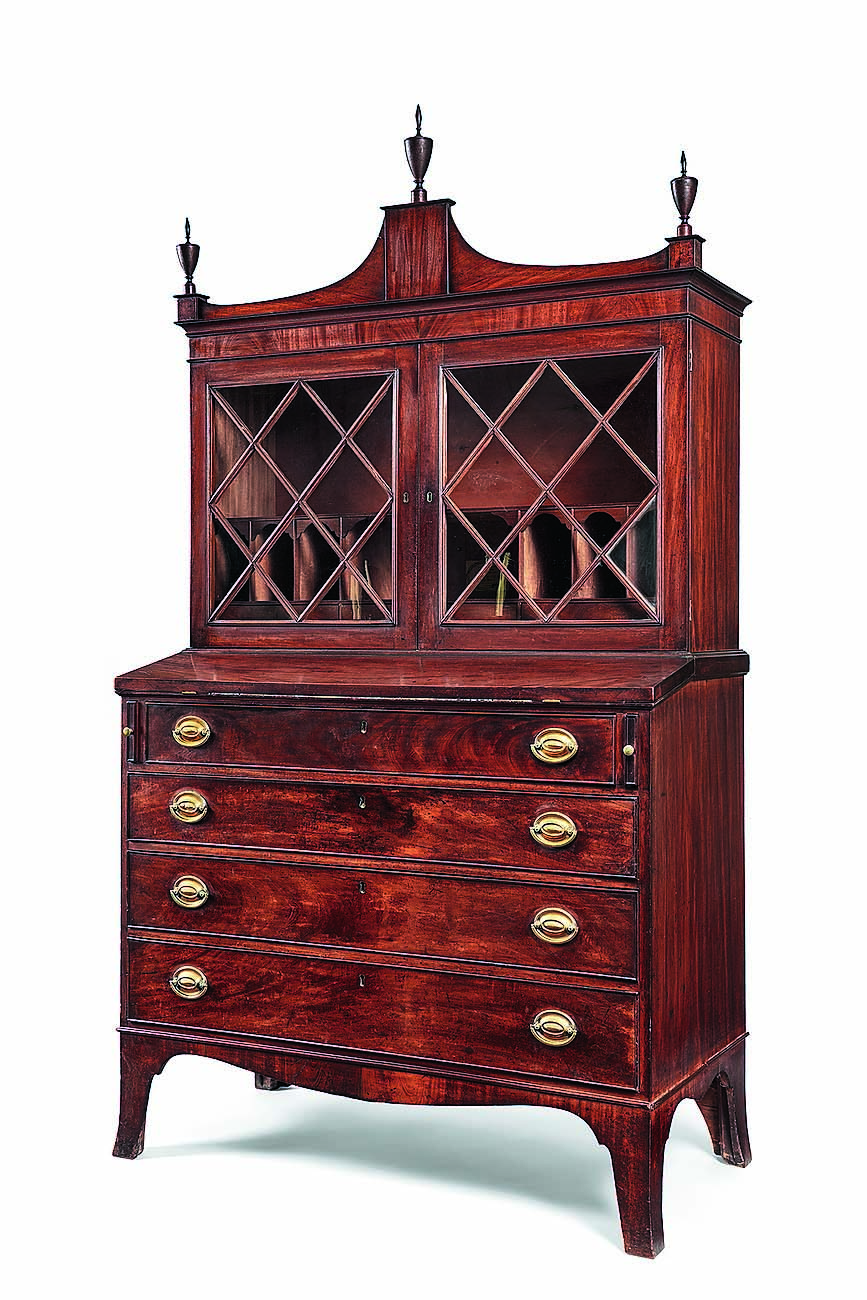
Desk and bookcase, labeled by Mark Pitman, Salem, Mass., 1807-12, mahogany, pine and glass, 67½ inches tall by 41⅛ inches wide by 20½ inches deep. Courtesy Peabody Essex Museum, given in honor of Dean Lahikainen and in memory of Anna Sterns by Anna Thurber, 2018. Michael E. Moses photo.

