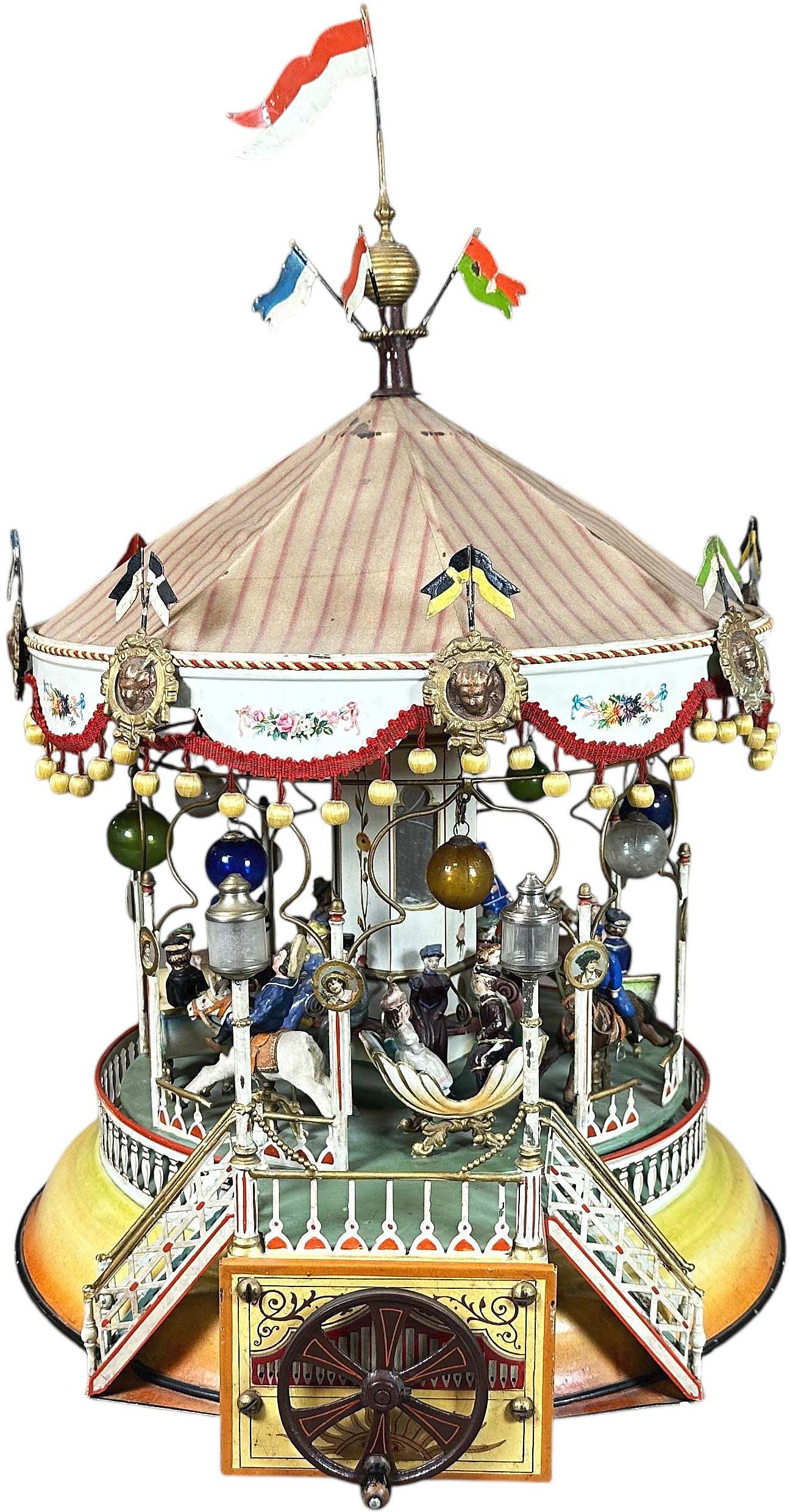
Top-lot status was awarded to this Märklin hand-painted musical carousel, 24½ inches high, which spun to $120,000 against an $80/140,000 estimate.
Review by Kiersten Busch
VINELAND, N.J. — Assembled over more than 60 years, the collection of the late Martin “Marty” Maloy and his wife, Deborah, was the sole focus of Bertoia Auctions’ December 13 sale, which garnered over $1.6 million in sales, with only two lots of the 400 offered going unsold at press time. Despite the bustle of the holiday season, Jeanne Bertoia was able to quickly comment that the sale was “Unbelievable. Spectacular. There are no words to explain how amazing it was!”
The top lot was a Märklin hand-painted musical carousel, purchased by Marty from the personal shelves of Jeanne’s late husband, Bill Bertoia. The 24½-inch-high piece was hand-painted and contained ornate railings, decorative lamp bulbs and its original striped canopy, alongside a handful of authentic figures enjoying their ride. Landing near the high end of its $80/140,000 estimate, the carousel rode to $120,000.
Märklin material continued to do well, with the second-highest price of the sale — $90,000 — sailing off to a Märklin Series II model of the battleship Brooklyn. The 35-inch-long clockwork-driven ship was made circa 1912-15, and was “the prize of Marty’s fleet,” according to catalog notes. It was accompanied by its original cradle stand and was in excellent to pristine condition, with only a few small replacement items.
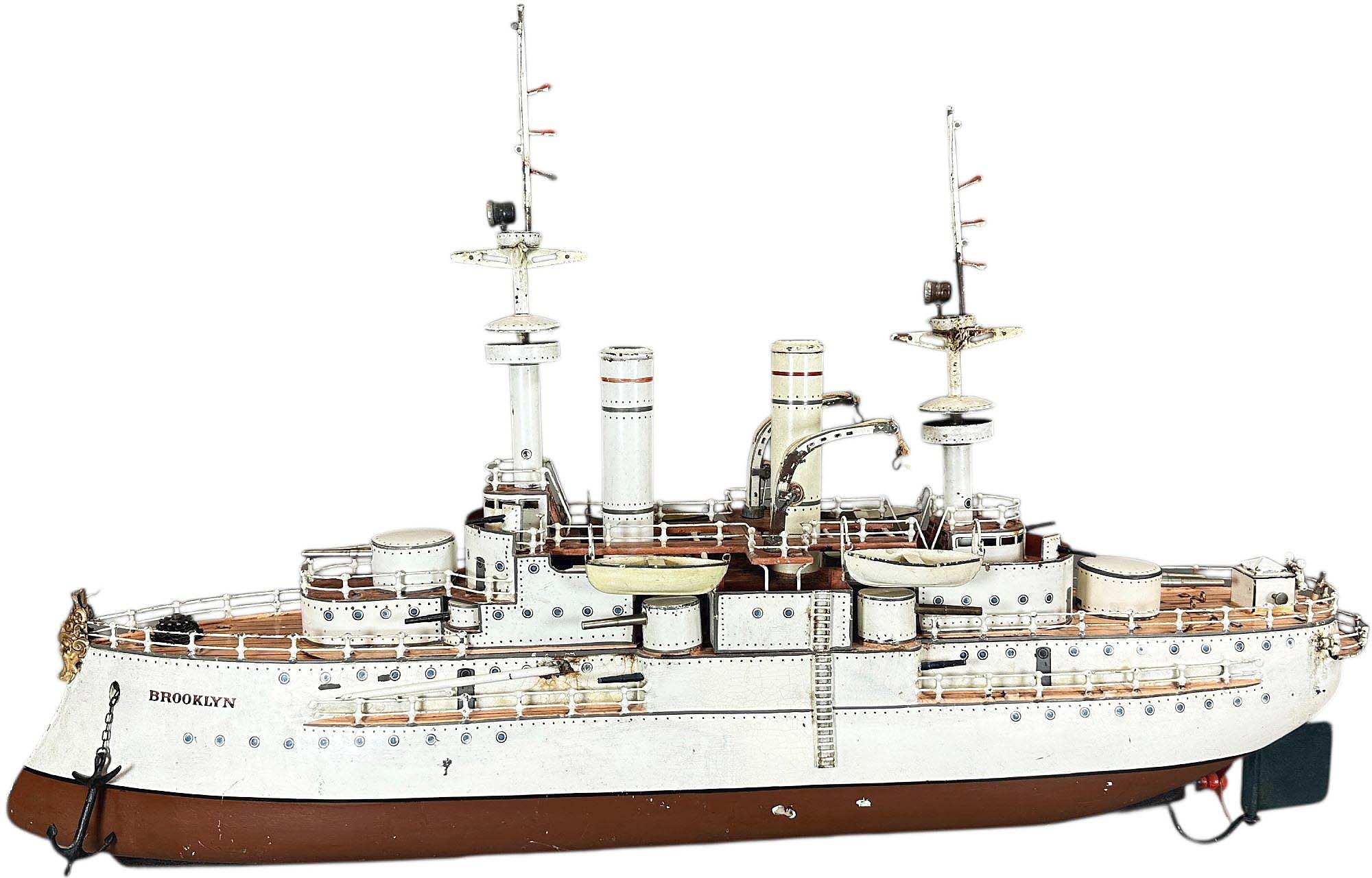
This Märklin Series II model of the battleship Brooklyn, circa 1912-15, 35 inches long, came with its original cradle stand and sailed to its new owner for $90,000 ($25/45,000).
A few other Märklin models also made a splash, including a live steam model of the torpedo boat Cleveland made circa 1906 ($22,800), a model of the paddle wheeler Philadelphia made circa 1900 ($20,400) and a gauge 1 US market Pacific Locomotive made circa 1908 and cataloged as “rare” ($19,200).
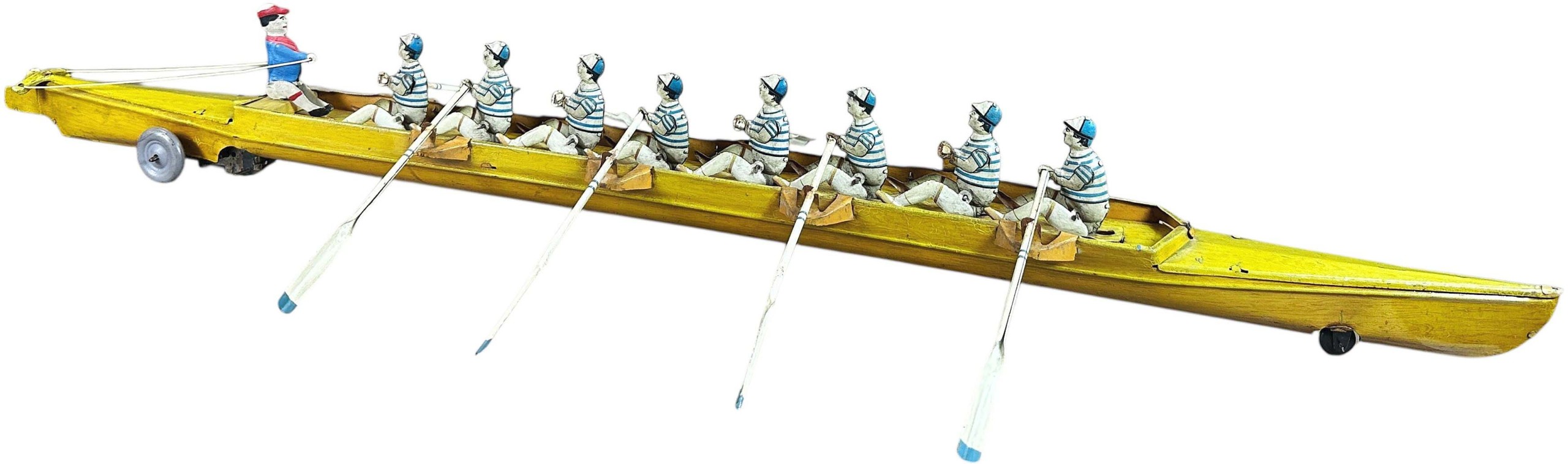
German model boats, even those not by Märklin, proved to be popular with bidders. A circa 1920 clockwork driven eight-man racing scull by Gunthermann more than doubled its $11,000 high estimate, racing to $27,600. According to the auction catalog, the boat was “a very elusive and fascinating toy with great action of synchronized rowing like an actual racing scull.”
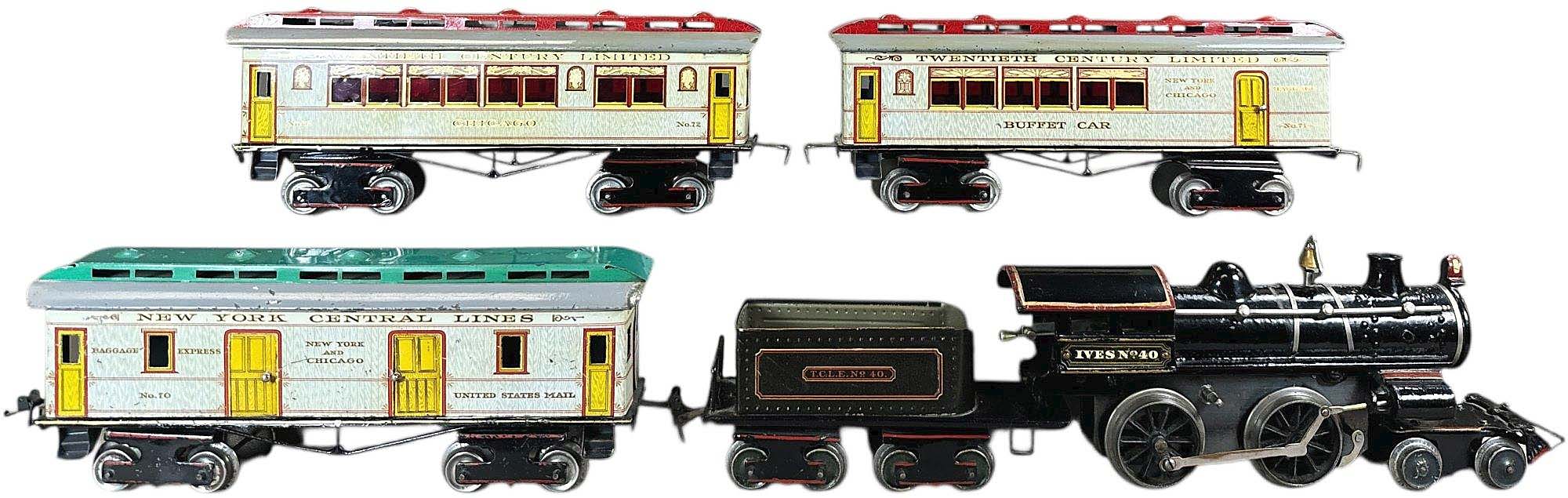
Nearly 35 lots of trains and toys made by Ives crossed the block, led by a No. 40 locomotive with a set of white Twentieth Century Limited cars, which sped past its $3/5,000 estimate to make $52,800. The remaining Ives lots ranged in price from $210 for an O gauge turntable, to $24,000 for a No. 25 O gauge clockwork-powered, four-band locomotive with “rare white cars.”
Cataloged as “reportedly the only known example” of its kind, a circa 1840 Francis, Field & Francis tin locomotive engine was “without a doubt the largest and earliest early American tin locomotive ever produced,” evinced by its wood planking design around its boiler. It far surpassed its $4/7,000 estimate, pulling into the station for $27,600.
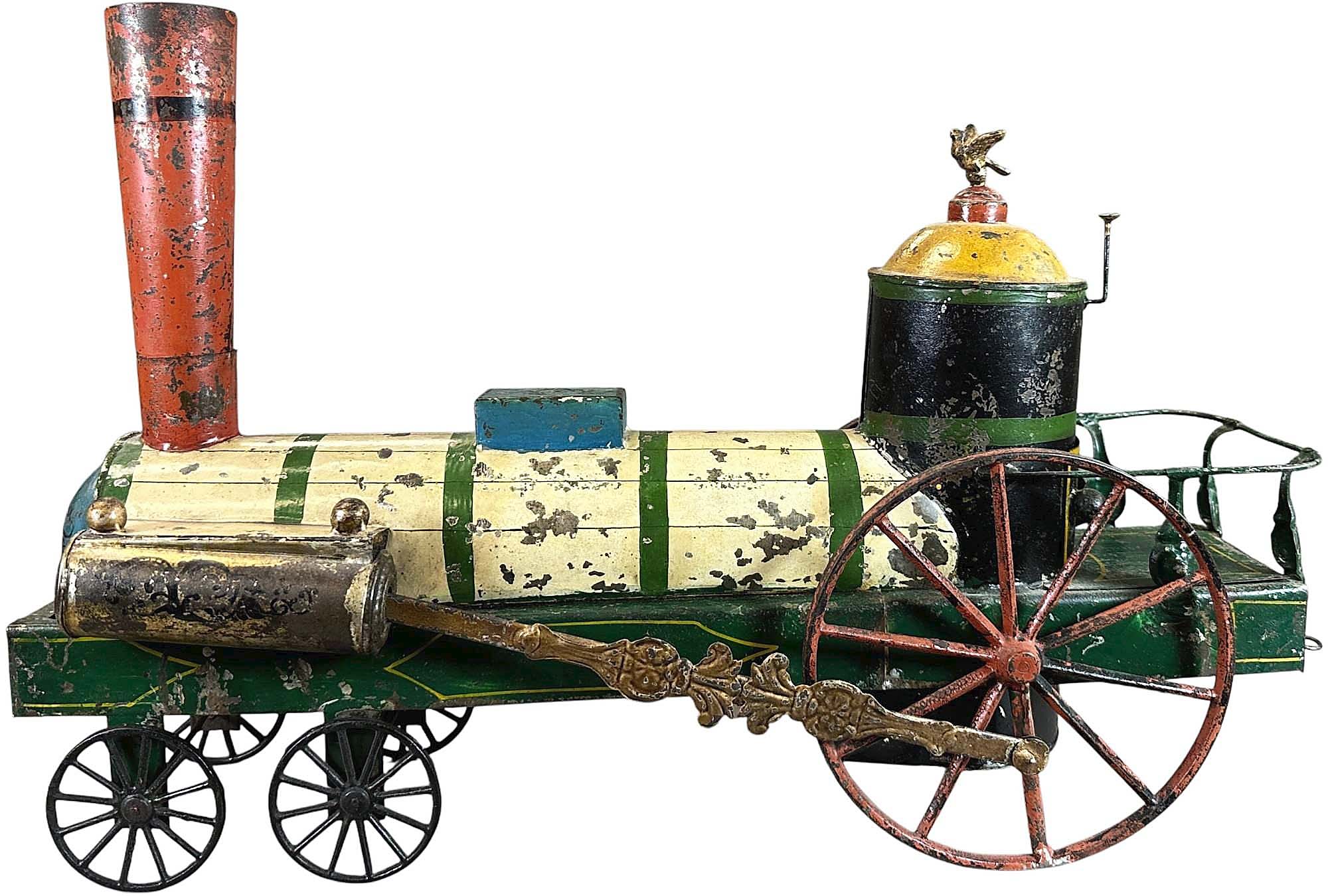
Most likely the only known example of its kind, this tin locomotive engine with wood planking, circa 1840, 18½ inches long, was made by Francis, Field & Francis and made $27,600 ($4/7,000).
A handful of tin motorcycle toys drove across the block, led with a wide margin by a 10½-inch-long green motorcycle with a sidecar attributed to a French maker, which was bid to $24,000. It was hand-painted and included a tinplate driver and a period figure in the sidecar.
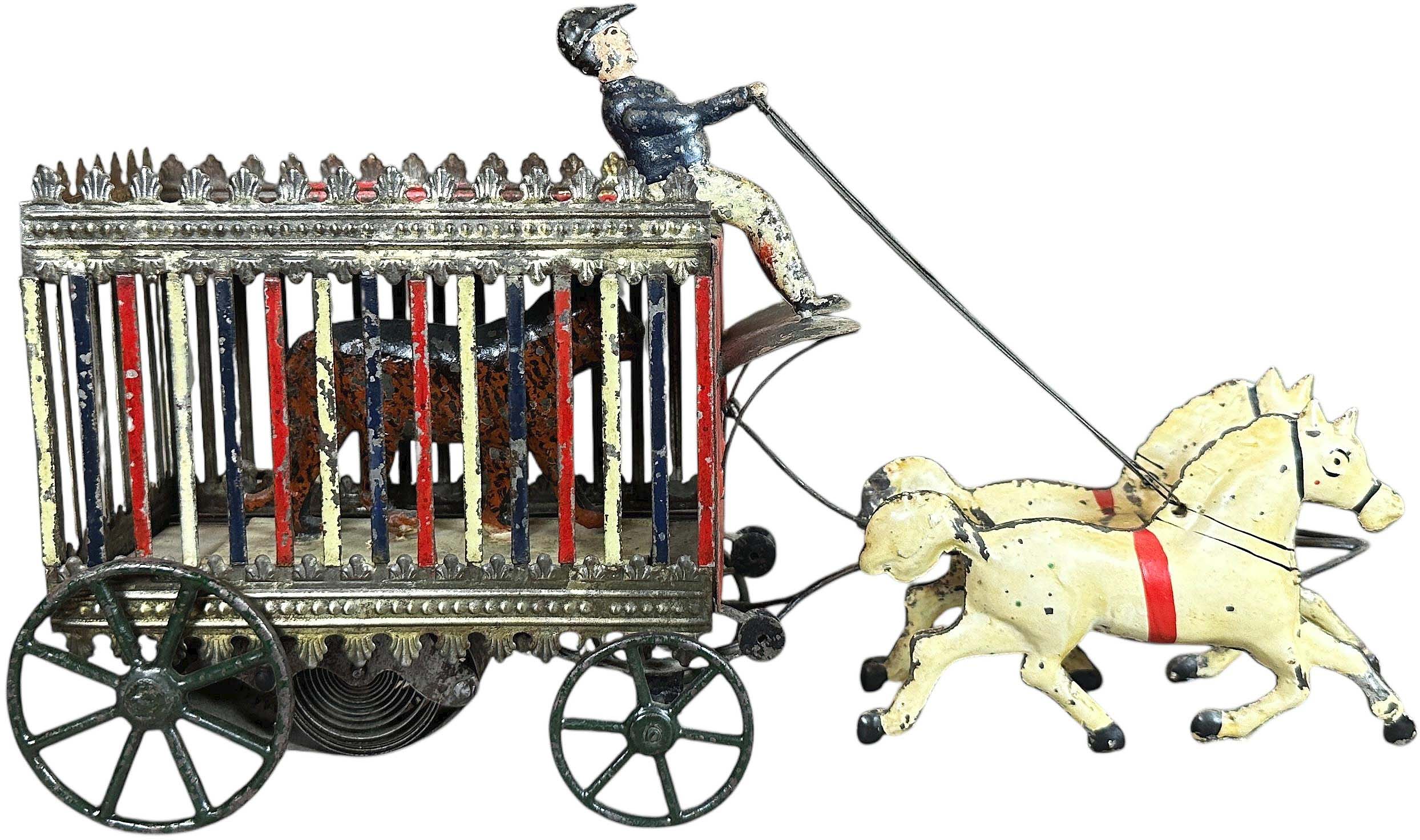
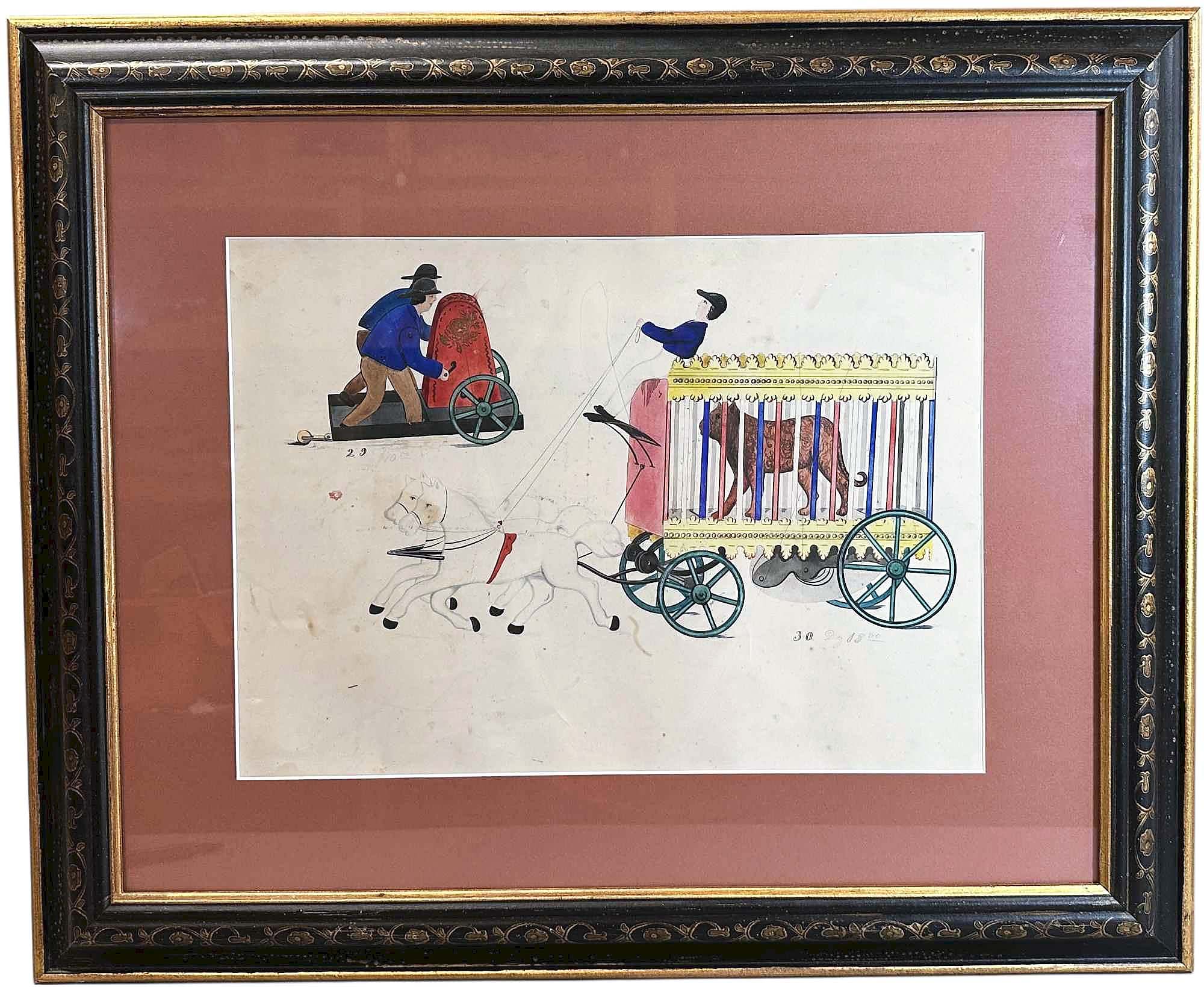
Cast iron toys by George Brown were in abundance, with a clockwork circus wagon exceeding its $12/20,000 estimate to achieve the top price of the selections at $20,400. The wagon, pulled by two white horses, also included a driver and a caged lion. Catalog notes explained that the piece was “exceedingly rare and very desirable,” as “only a few [were] known to have survived the last century.” It was also noted as having appeared in the George Brown Sketchbook. A framed sketch from said book of the circus wagon, or a very similar example, was offered as well, and sold for $14,400. The line drawing was supposedly color-tinted by Brown himself and pictured the toy in its real-life size.
The highest-earning, or highest-flying, model airplane was a Mohr & Krauss bi-wing example, cataloged as “large” due to its 15-inch wingspan. The Twentieth Century German-made plane had wind-up motor to power its rear propeller and primarily authentic wings.
Prices quoted include buyer’s premium as reported by the auction house. For additional information, 856-692-1881 or www.bertoiaauctions.com.